
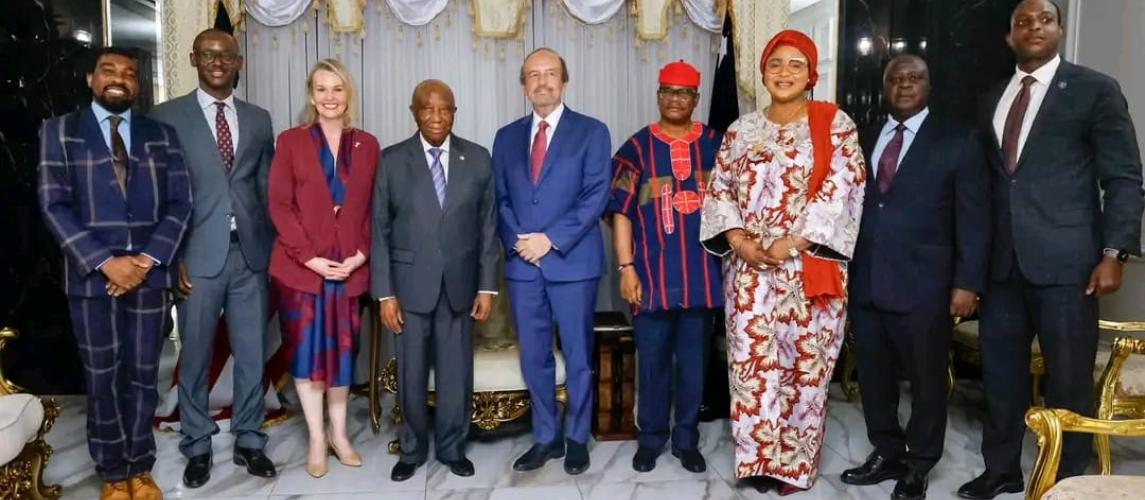
President Boakai Receives Briefing on Millennium Challenge Corporation Compact Development Talks, Focusing on Electricity and Mining Reforms
Presenting the report on the progress of the engagement, National Coordinator Dr. Nyien, disclosed that the exercise has enjoyed the strong support of the Ministry of Finance and Development Planning and relevant sector institutions, as the country works to advance the proposed compact.
He informed the President that the process is now moving into a phase focused on identifying and designing projects for the two priority sectors, electricity infrastructure and mining sector reforms, with the goal of promoting economic expansion. National Coordinator Nyien further noted that the decision to focus on the electricity sector was informed by the Team’s understanding that the MCC has tried to explore sectors that can promote economic growth in the country.
On electricity, the Compact Development Team leaders informed the President that the proposed compact is expected to prioritize investment in transmission infrastructure, including the expansion, rehabilitation and construction of new transmission facilities.
The Team leaders said the initiative is also expected to support reforms in the governance of the electricity sector to encourage greater private-sector participation in power generation and improve efficiency in electricity distribution.
As for the mining sector, it was stated that the Government will need to pursue legal and regulatory reforms aimed at strengthening the country’s capacity to negotiate mining agreements and protect national interests.
Dr. Nyien, in his report, pointed to some gaps in the existing legal framework, which was formulated nearly two decades ago in 2007. “We want to be able to finalize the development of a new legal framework for the country, having data that is accurate, so that when we go into negotiations of new contracts, we are not shortchanging Liberia," the MCC National Coordinator revealed.
Receiving the report on the progress of the engagement, President Boakai highlighted the Government’s commitment to accelerating the process and working with the MCC to develop projects that address Liberia’s development priorities.
In the discussions that followed the briefings, it was noted that the Government considers technical support to strengthen its capacity to evaluate investment proposals and negotiate agreements. This will ensure that contracts reflect Liberia’s interests and deliver greater benefits to the country.
As part of the next steps, an electricity options and readiness study was found to be as needed so as to identify potential investment options and determine the requirements for implementing the preferred approach. This study is expected to provide recommendations by January 2027, giving the Government a basis for deciding which electricity investment option to pursue with the MCC.
The MCC Development Team made it clear that its compact development model is based on cooperation with partner countries rather than imposing predetermined projects. Under this approach, Liberia identifies its development challenges and priorities, while the MCC collaborates in the developing and implementing appropriate solutions.
The Team stressed that the pace of progress will depend on continued coordination between the Liberian government and the MCC, with the Government seeking to move the process forward as quickly as possible.
Climaxing the session, President Boakai lauded the Team for the development of the proposed compact and expressed confidence in the expectations set for the compact, which aim to support Liberia’s broader economic development objectives by addressing persistent electricity constraints and strengthening the legal and institutional framework governing the mining sector.
